For a system like Aireon’s, resilience is fundamental. Delivering continuous, real-time surveillance data to customers around the world requires more than redundancy on paper – it requires the ability to transition seamlessly when it matters.
This is exactly what Aireon set out to achieve with its “Hot-Hot” architecture.
The concept is simple: instead of relying on a single active data path, the system maintains two independent, continuously active paths (“Hot-Hot”). While the primary path is in use, the redundant path is muted.
Aireon’s data service architecture is supported by four key sites: the primary Hosted Payload Operations Center (HPOC) in Leesburg, Va.; the backup HPOC at the Technical Support Center (TSC) in Chandler, Ariz.; and the primary and backup Aireon Processing and Distribution (APD) customer service sites in Ashburn and Herndon, Va.
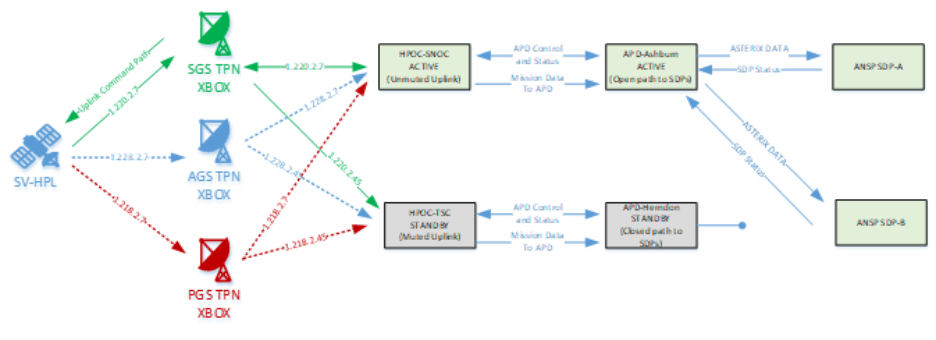
Prior to Hot-Hot, Aireon operated with a single active path. In the event of a disruption, restoring service required a manual switchover across multiple layers of the network and which required a four-hour window for the switchover.
Hot-Hot was designed to significantly reduce that window to only 30 minutes.
The next step was to test the actual Hot-Hot switchover process. As part of maintaining Aireon’s EASA certification and in response to customer expectations, the team transitioned live operations from the primary segment (SNOC–Ashburn) to the backup segment (TSC–Herndon). This marked the first time the system had been operated entirely from its redundant path.
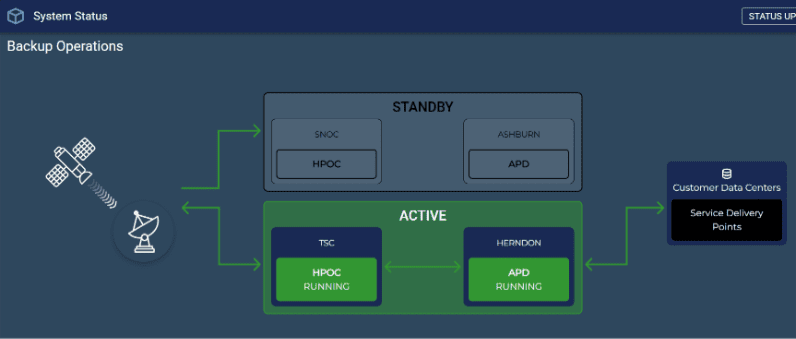
The switchover was conducted over two separate days a week apart. In all, the effort was completed quicker than expected, and customers did not experience any significant disruption to their service. In addition to validating the architecture, the transition enabled planned maintenance at the primary site—demonstrating that the capability is not only valuable for contingency scenarios, but also for routine operational needs.
Following completion of maintenance activities, Aireon executed the transition back to the primary segment a week later. This switchback was completed in just 23 minutes and the primary site was restored to full operational capability, reflecting both increased efficiency and growing operational confidence and the SNOC was restored to full operational capability!
“Achieving full data redundancy with our Hot-Hot architecture marks a major step forward in operational resilience. These milestones demonstrate that our approach is not only conceptually sound but also works in practice — reducing recovery time from hours to under an hour while ensuring seamless, reliable service our customers can trust,” said Vinny Capezzuto, Chief of Operations.
Just as importantly, the effort highlights the level of coordination and preparation across teams required to successfully execute a transition of this scale. The experience gained will continue to inform operational procedures and support future system evolution.