
GNSS jamming and spoofing are no longer isolated safety concerns, they have become a persistent operational reality for the entire aviation community. Over the past two years, Aireon has detected an increase in both spoofing and interference issues across all regions.
As navigation signals get manipulated, aircraft and air traffic controllers are confronted with unreliable or mismatched positional data, creating potential operational and safety risks. Aireon’s technology provides real-time detection and mitigation capabilities, offering a fully independent layer of trust in contested environments.
Global Navigation Satellite Systems (GNSS) – like GPS and Galileo – are at the heart of modern aviation. They underpin both navigation and surveillance, from flight-management systems, performance-based navigation routes, and cooperative surveillance for air traffic control. However, GNSS signals are inherently vulnerable; they can be disrupted, degraded, or deliberately spoofed. This creates a vulnerability for the aviation community by providing position information that appears valid, but is not.
Traditional aircraft avionics rely on multiple subsystems to detect degraded accuracy, but increasingly sophisticated spoofing techniques can bypass these internal checks, delivering false GNSS data that appears to be nominal. In these situations, neither the flight crew nor ATC may be aware of the error. Without an independent mechanism to detect these events, aviation stakeholders are left vulnerable.
Aireon has developed a game-changing countermeasure: the Independent Position Check (IPC). This proprietary capability provides a GNSS-independent layer of positional assurance and surveillance. The technique leverages a time difference of arrival (TDOA) algorithm, enhanced by the positional and timing precision of Aireon’s satellite-based infrastructure. This enables Aireon to detect when an aircraft’s position, or the position of a spoofed source, deviates from the location of transmission. Put simply, Aireon can verify an aircraft’s true position, even when the aircraft is unaware.
This capability is already transforming how operators, regulators, and ANSPs can detect and respond to spoofing and jamming events. Rather than relying on GNSS, Aireon provides a trusted, independent aircraft position source through our new AireonVECTOR product suite.
The risks of GNSS spoofing and jamming are no longer theoretical. They are happening today across all regions and the risk is increasing. Aireon’s IPC capability is actively monitoring these events in real-time, providing a critical layer of situational awareness.
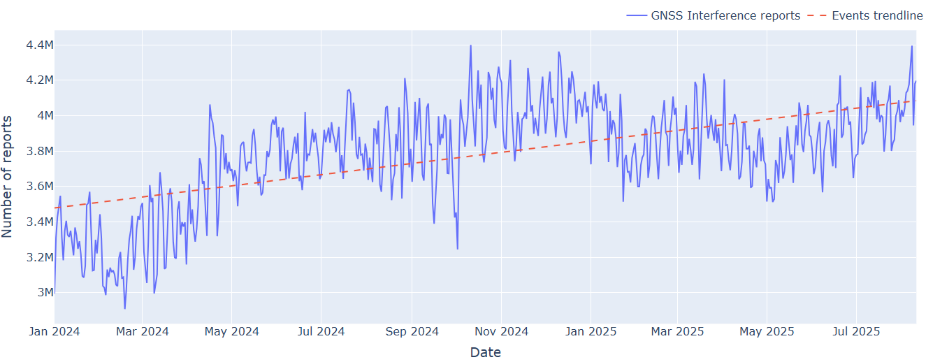
Between January 2024 and July 2025, Aireon observed a steady rise in GNSS interference activity across all regions; the above graph illustrates this trend. The blue line shows the daily number of events detected by Aireon’s system and the red line shows the increasing trend. This increase is persistent, signaling that GNSS spoofing and jamming are no longer isolated regional issues, they have become a sustained operational reality for aviation.
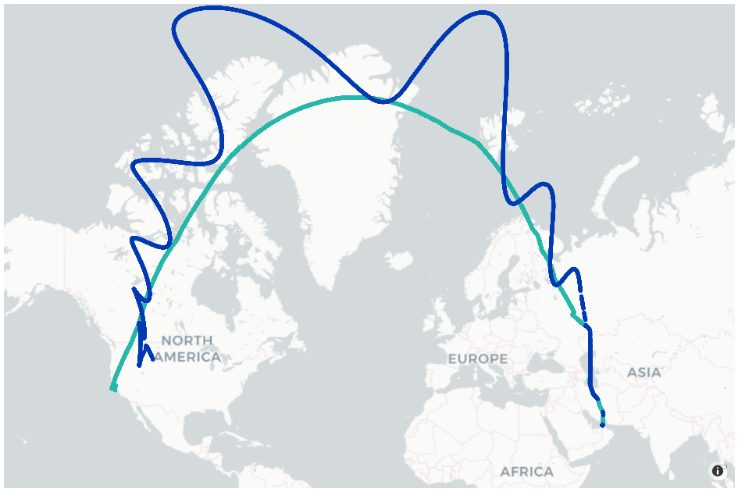
One example of this occurred during a September 2024 flight from Dubai to San Francisco. Early in the route, the AireonVECTOR Flight data perfectly matched the aircraft’s ADS-B data. However, shortly after entering a new airspace, Aireon’s IPC was triggered, and the ADS-B data began to deviate from the AireonVECTOR Flight data.
Event analysis has shown that GNSS interference affected the aircraft’s GPS receiver, and the aircraft was unable to recover for the remainder of the flight. It continued to transmit unreliable ADS-B positions, visible in the sinusoidal pattern in blue. However, Aireon’s data (shown in teal) reveals the true position of the aircraft.
This example illustrates how regional interference can persist beyond the initial point of exposure, compromising positional integrity for the entire duration of a flight.
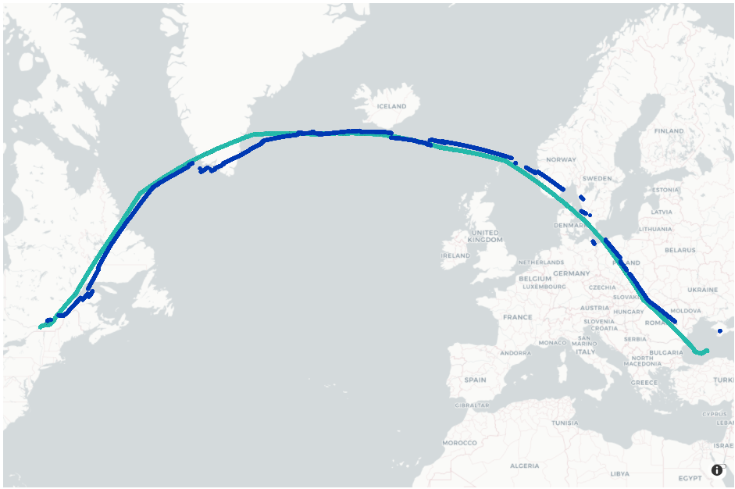
Another example occurred during an April 2024 flight from Delhi to Quebec (pictured above). Early in the flight, AireonVECTOR Flight data and the aircraft’s positional data remained in close agreement. However, after the aircraft entered airspace over the Black Sea/Baltic regions, Aireon’s IPC algorithm triggered a potential spoofing event.
During this event, the aircraft’s onboard systems continued to indicate high positional integrity, even as the ADS-B track (blue) clearly shows discontinuities and divergence from Aireon’s independently derived position data (teal).
This example highlights another potential risk; the aircraft may be unaware of its own compromised position, leaving ATC and the pilot exposed to operational and safety risks.
So how does IPC and AireonVECTOR work?
Each ADS-B message from an aircraft is picked up by multiple satellites in the Iridium constellation. Using the GNSS independent timing of the Iridium network, Aireon compares the arrival times of those identical messages and can calculate when an aircraft is more than three nautical miles away from its broadcast position. With the addition of the IPC data point, we can triangulate an aircraft’s actual position even if GNSS is compromised.
This powerful tool is embedded across the AireonVECTOR suite of products. For example, within the Safety Dashboard, you can identify specific events of spoofing and jamming across your airspace and monitor your airspace for trends. AireonVECTOR Flight offers an independent surveillance feed, fully GPS-independent. Within our Air Traffic Surveillance services, tracked data which appears good, but is in fact being spoofed, can be flagged and then removed by air traffic control automation systems.
Aireon is directly addressing the growing threat of GPS interference with real-time, actionable intelligence. Providing an independent layer of positional assurance through the Independent Position Check (IPC), Aireon empowers aviation stakeholders to detect, monitor, and respond with confidence and trust.
